The Summer Sky
The summer sky is filled with beautiful nebulae and star clusters. Longer days mean later start times and fewer hours for astrophography, but staying up later yields some beautiful results. Deep Sky Objects (DSOs) move from east to west as the Earth rotates, and are at their highest point in the sky when they are due south. |
The View to the South
The view to the south is looking within the plane of our Milky Way Galaxy where bright gaseous nebulae are the birthplace for new stars. The Milky Way is a barred spiral galaxy with a diameter of about 87,000 light-years, but with spiral arms only about 1,000 light-years thick. Our Sun, which is only one of the estimated 100 to 400 billion stars in the Milky Way, is located about 27,000 light-years from the galactic center. |
 The summer sky looking south at midnight (image courtesy Stellarium) |
The Sagittarius and Serpens Region
This is my favorite region of the sky for photographing nebulae. Sagittarius is located in the direction of the Milky Way galactic center, and is therefore rich with nebulae and star clusters. The bright globular cluster, M5, located in Serpens, and is one of the oldest globular clusters in our Milky Way Galaxy. There are several bright globular clusters in the southern region of Sagittarius, including M22 and M55. Annotations show the locations of my astrophotos. |
 The Sagittarius and Serpens Region (background image courtesy Stellarium) |
Click on thumbnails for larger images.
 Lagoon (M8) Nebula  Trifid Nebula (M20) & M21 Open Cluster 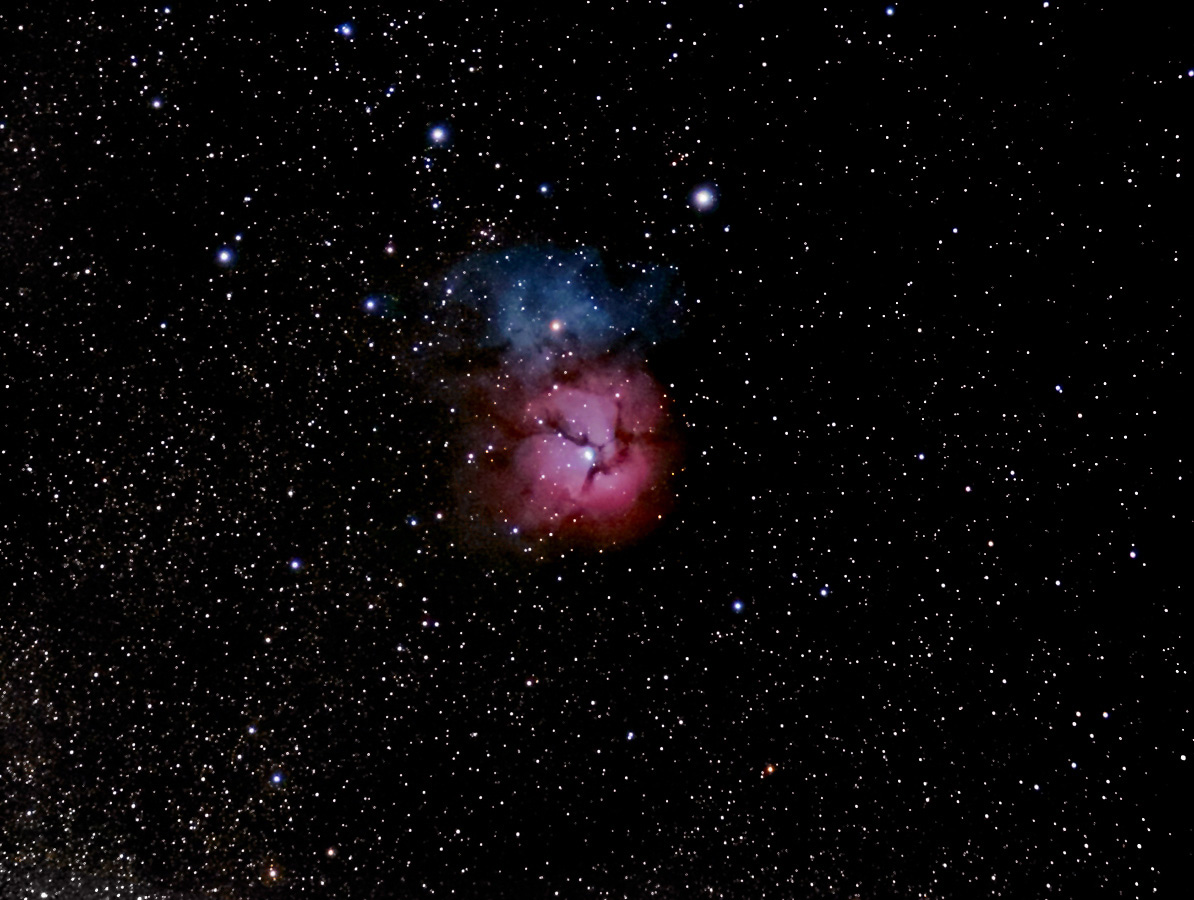 Trifid Nebula (M20) | ||
 Lagoon (M8) & Trifid (M20) Nebulae  Omega (M17) & Eagle (M16) Nebulae  Sagittarius Region |
 Omega Nebula (M17)  Omega Nebula (M17)  Eagle Nebula (M16) 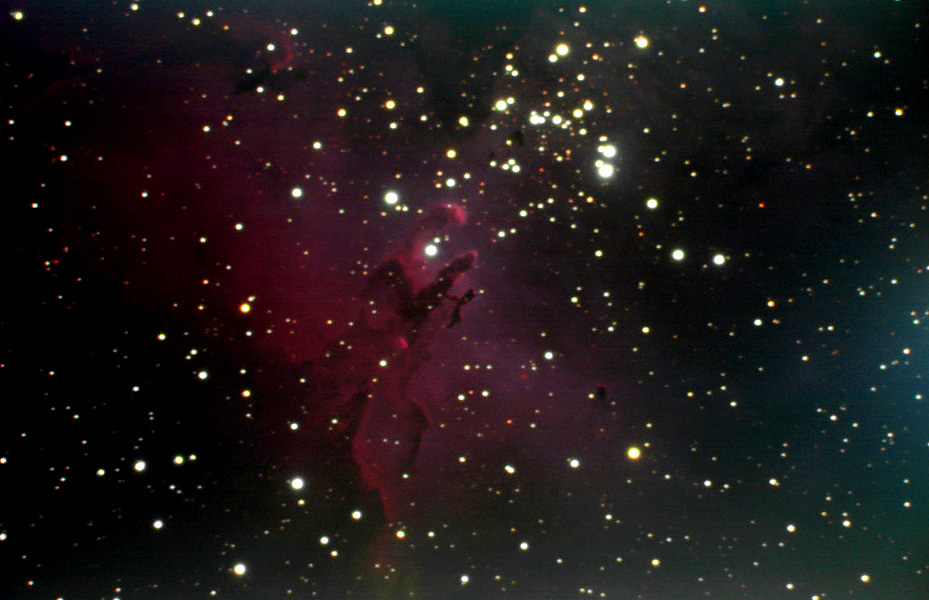 Eagle Nebula (M16) |
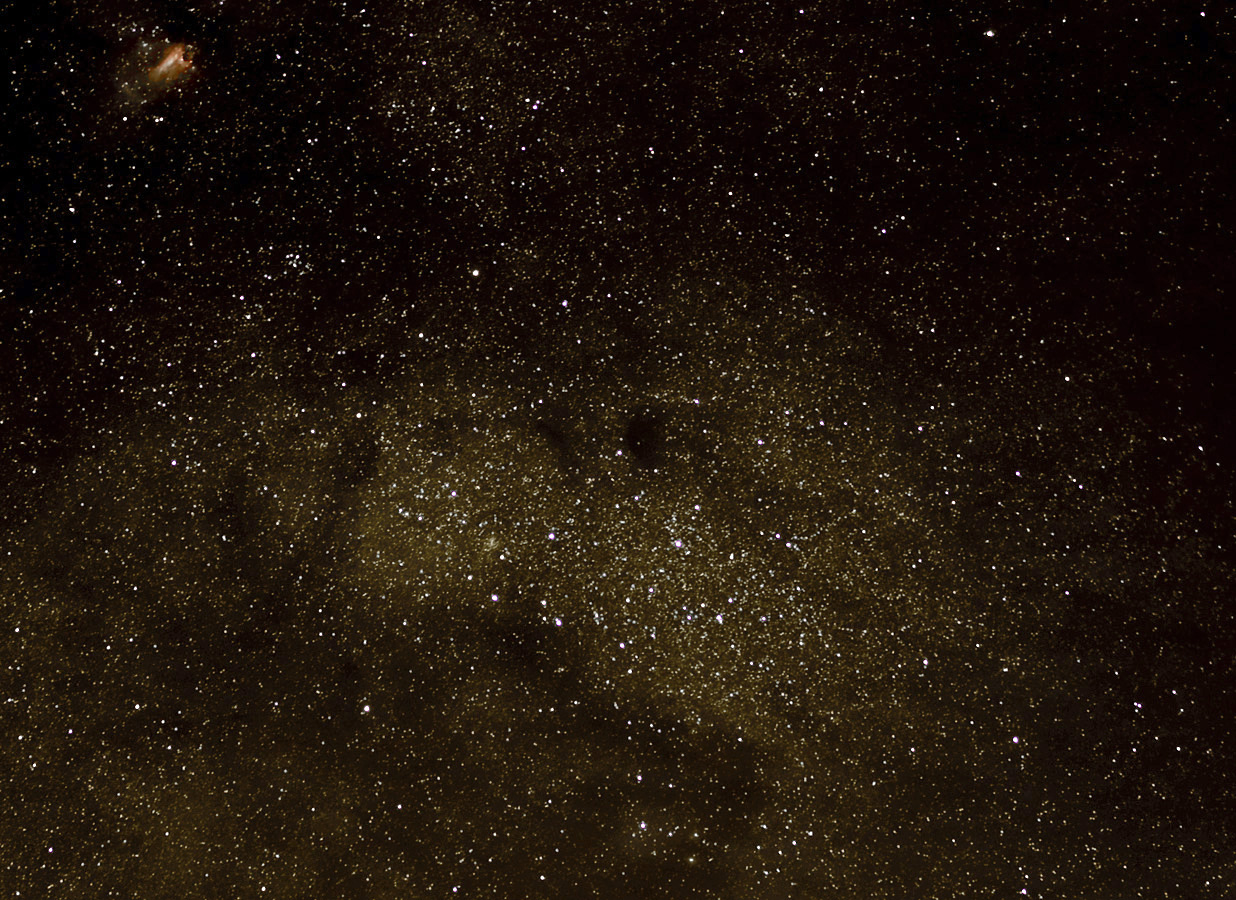 Small Sagittarius Star Cloud (M24) 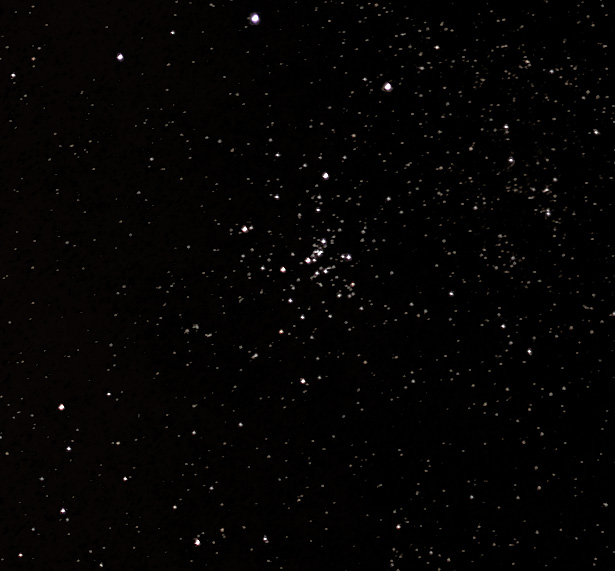 M25 Open Cluster |
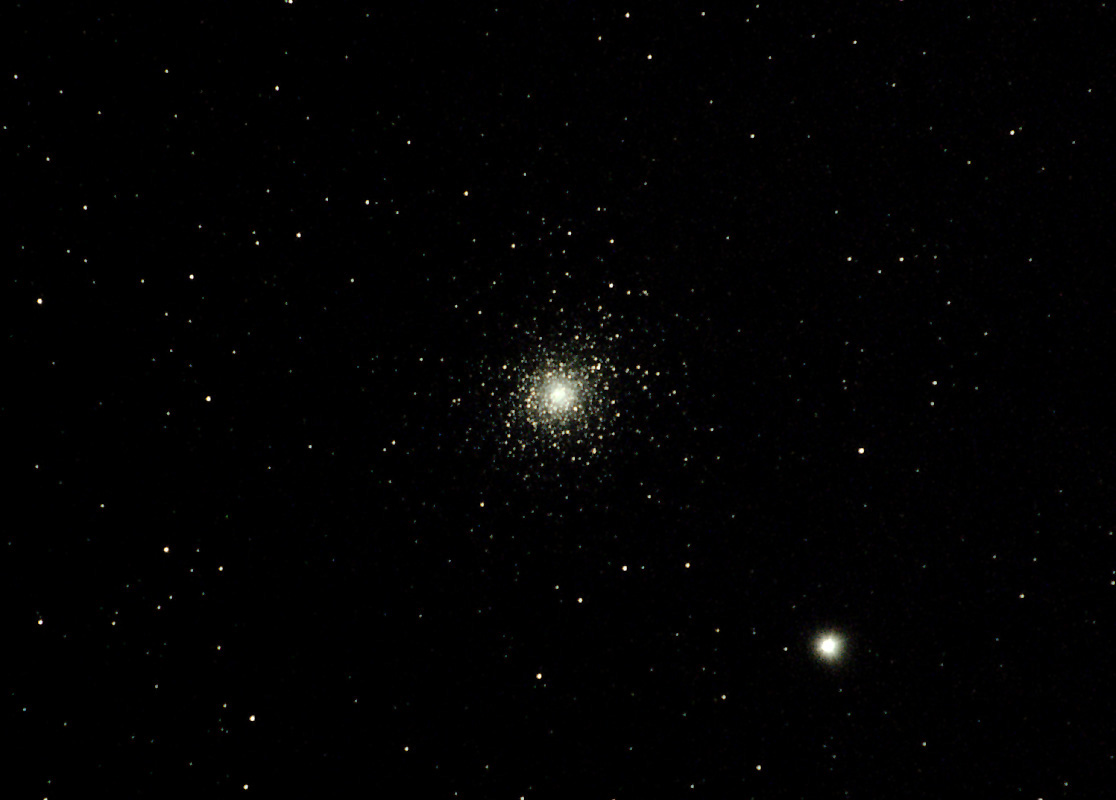 M5 Globular Cluster  M22 & NGC6642 Globular Clusters  M55 Globular Cluster  M6 & M7 Open Clusters | |||
 Wild Duck (M11) Open Cluster  Black Swan (M18) Open Cluster  Webb's Cross (M21) Open Cluster 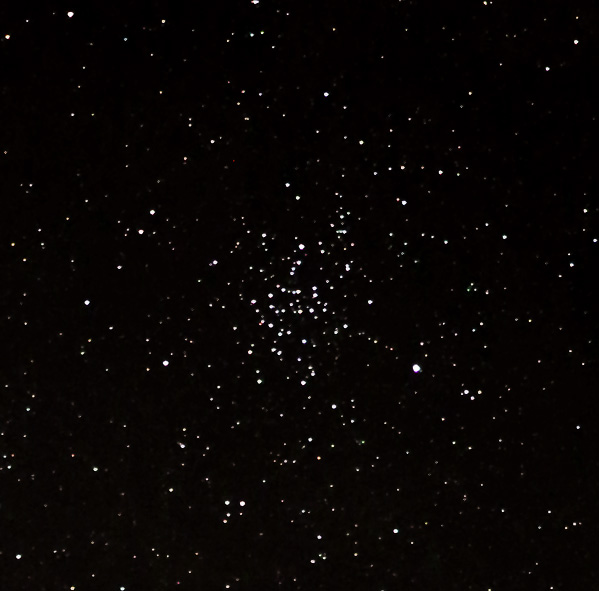 M23 Open Cluster |
The Opiuchus Region
The constellation of Ophiuchus contains six bright globular clusters, and I have photographed three of them. The star rho Ophiuchi is surrounded by a "U-shaped" reflection nebula, and is located near the bright star Antares (in Scorpius). The rho Ophiuchi region is one of the most colorful areas in our sky, but unfortunately never gets very high above the horizon when viewed from mid-northern latitudes, making it difficult to capture good photos. Annotations show the locations of my astrophotos. |
 The Opiuchus Region (background image courtesy Stellarium) |
Click on thumbnails for larger images.
 M10 Globular Cluster 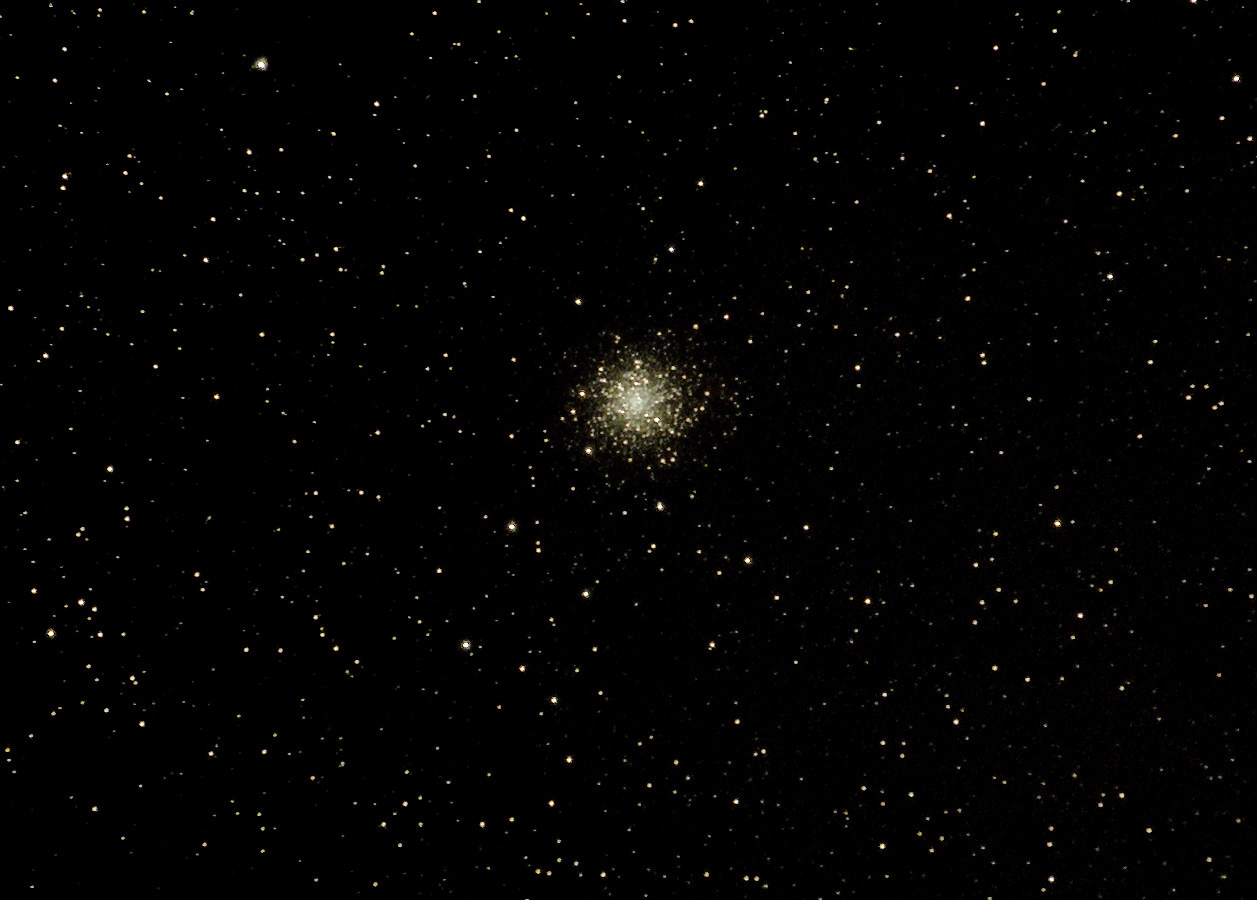 M12 Globular Cluster 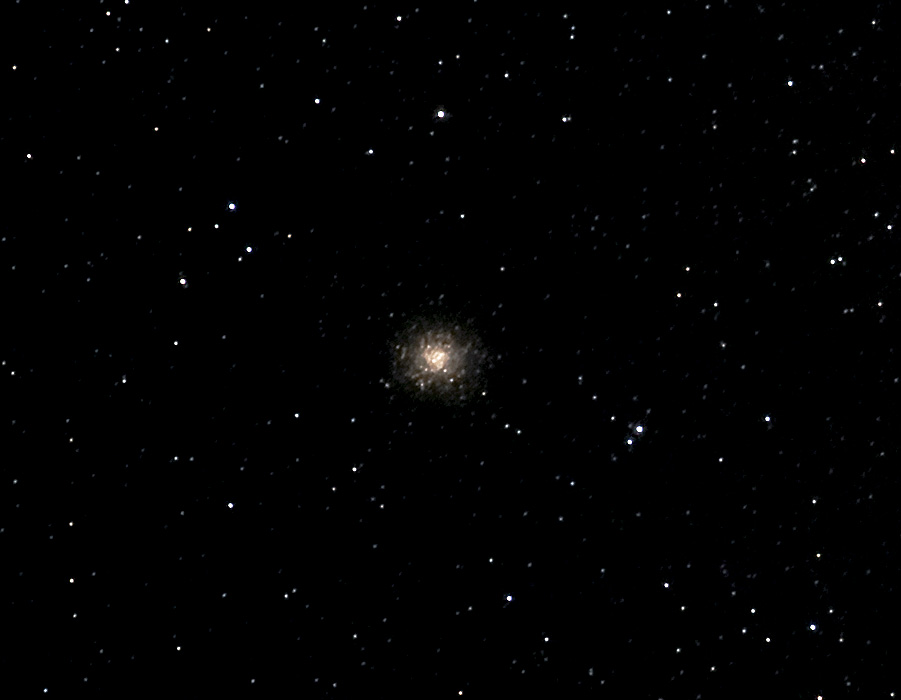 M14 Globular Cluster | ||
 M10 & M12 Globular Clusters  Rho Ophiuchi Region M4 globular cluster  M4 & NGC 6144 Globular Clusters |
The Zenith Region
Near the zenith, I have photographed three globular clusters (M13, M71 and M3), as well as two planetary nebulae: Ring (M57) and Dumbbell (M27). M13 is known as the Great Globular Cluster in the constellation of Hercules because of its apparent size and brightness. Spiral galaxy NGC 6207 is seen close and to the left to M13. |
 The Zenith Region (background image courtesy Stellarium) |
Click on thumbnails for larger images.
 M13 Globular Cluster  M13 Globular Cluster 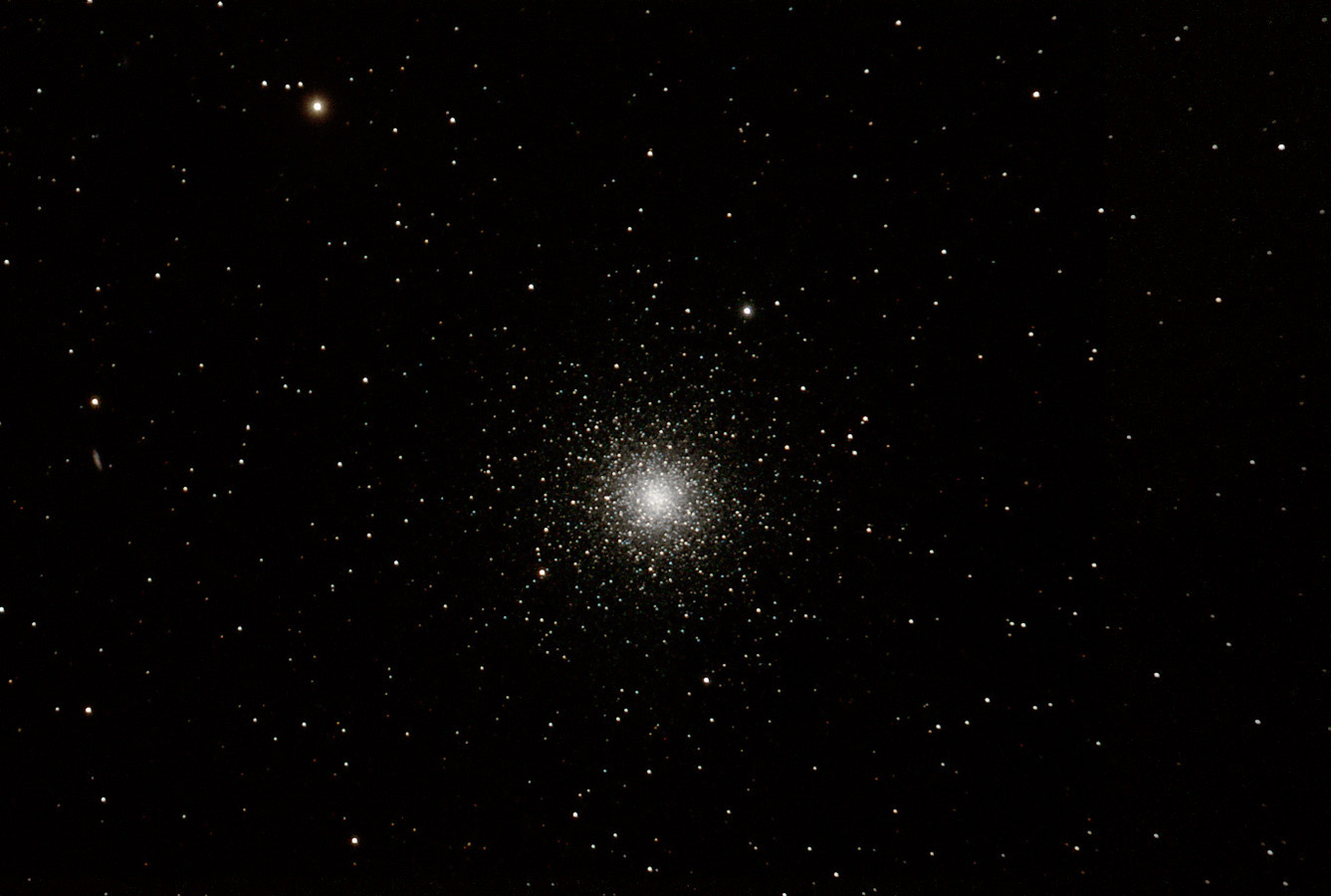 M3 Globular Cluster | ||
 Ring Planetary Nebula (M57)  Dumbbell Planetary Nebula (M27)  M71 Globular Cluster |
The View to the North
The view to the north also shows the plane of our Milky Way Galaxy, and DSOs near the celestial pole (Polaris) come into view. At my latitude for astrophotography, Polaris is located 38 degrees above the horizon. All of the DSOs within a circle of 38 degrees from Polaris will be visible all year long, but many of them will be too close to the horizon to be easily seen through the dense atmosphere.  38 degree circle around Polaris (background image courtesy Stellarium) |
 The summer sky looking north at midnight (image courtesy Stellarium) |
The Milky Way Region
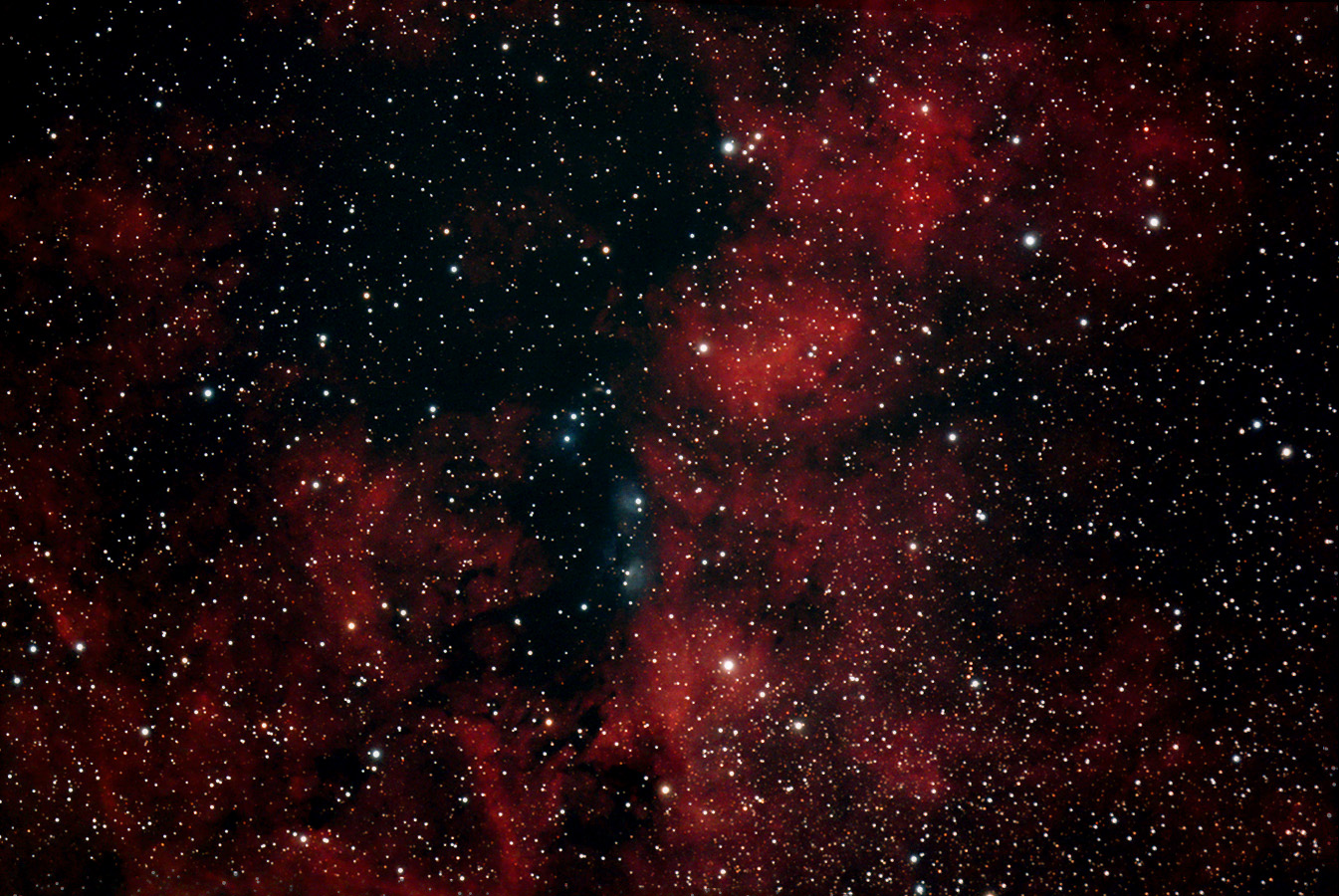
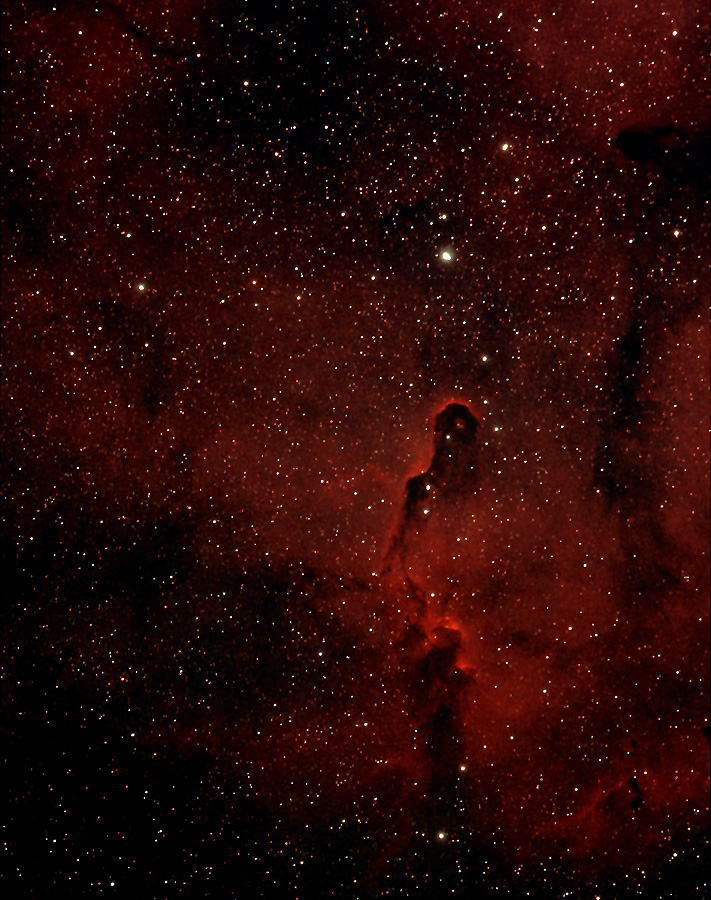
The North American Nebula (NGC 7000), named for its shape, is the focal pont of this region. The Pelican Nebula (IC 5070) is nearby, and the extensive Gamma Cygni Nebula (IC 1318) and the Elephant Trunk Nebula (IC 1396) combine with the North American Nebula to form a dramatic view of this portion of the Milky Way. Closer to the horizon, you can see the Heart and Soul Nebulae (IC 1805 and IC 1848), with nearby double open star cluster h & chi Persei (NGC 869 & NGC 884). The h & chi Persei double cluster was the subject of my first ever astrophoto (1968). |
 The summer sky looking north at midnight (background image courtesy Stellarium) |
Click on thumbnails for larger images.
 North American (NGC 7000) & Pelican Nebulae (IC 5070) 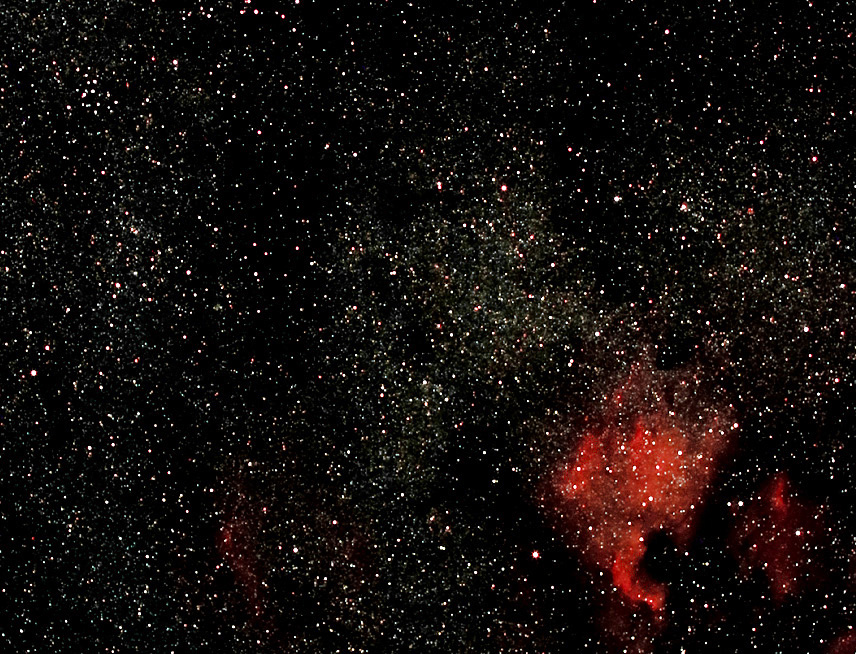 North American (NGC 7000) & M39 Open Cluster  IC5076 Reflection Nebula |






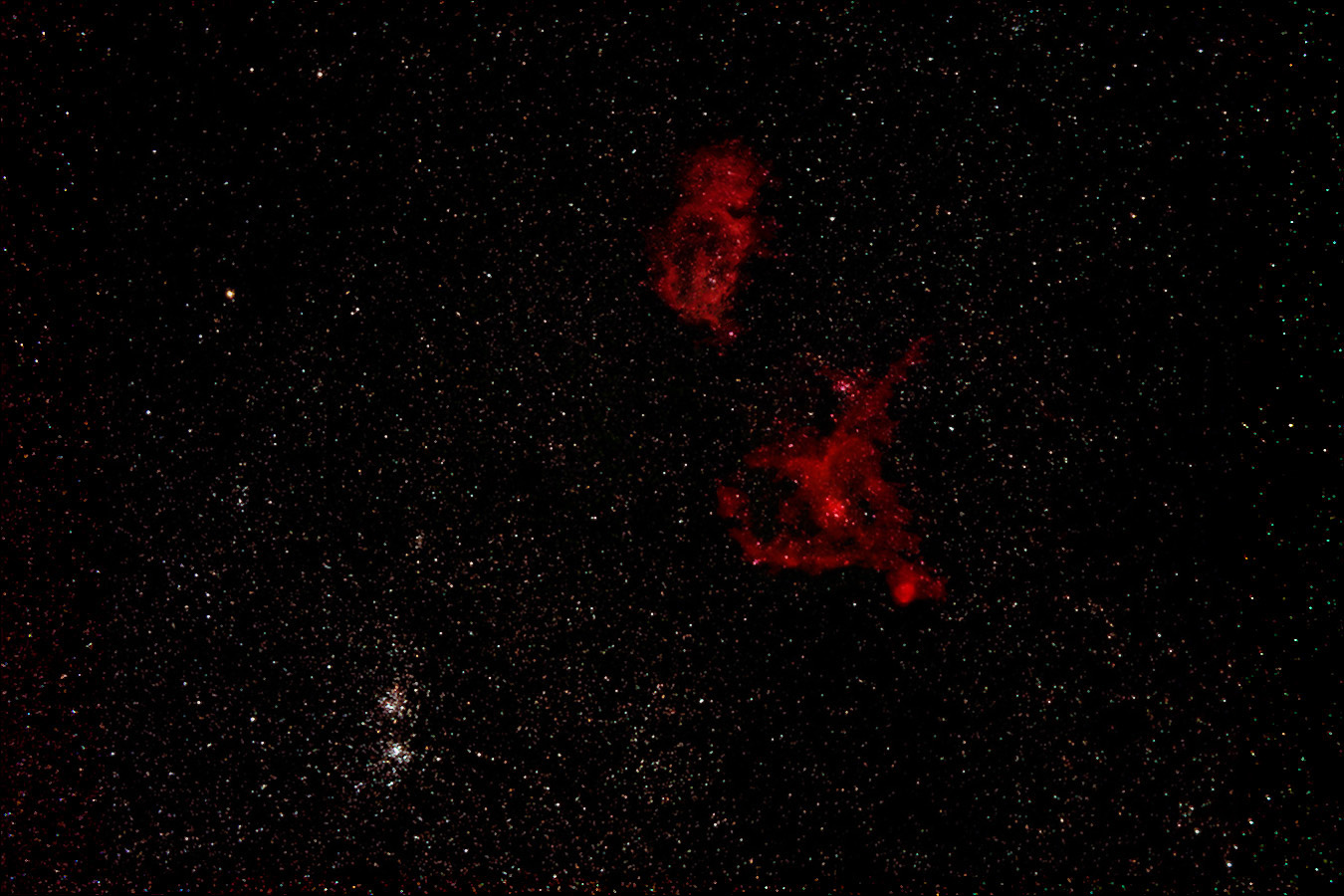
 Ghost of Cassiopeia Nebula (IC 63) 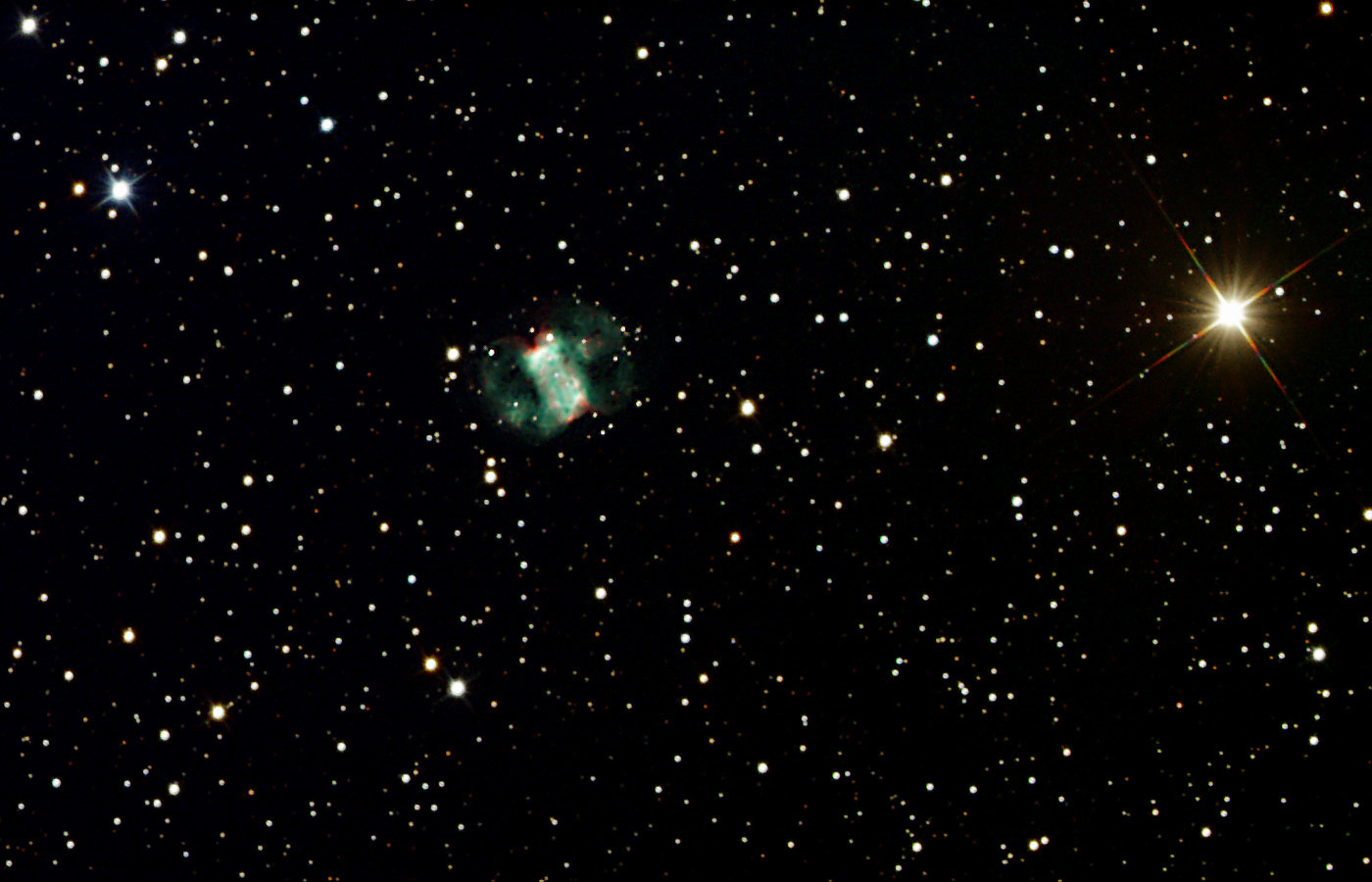 Little Dumbbell Nebula (M 76)  Heron Nebula (NGC 5394) |
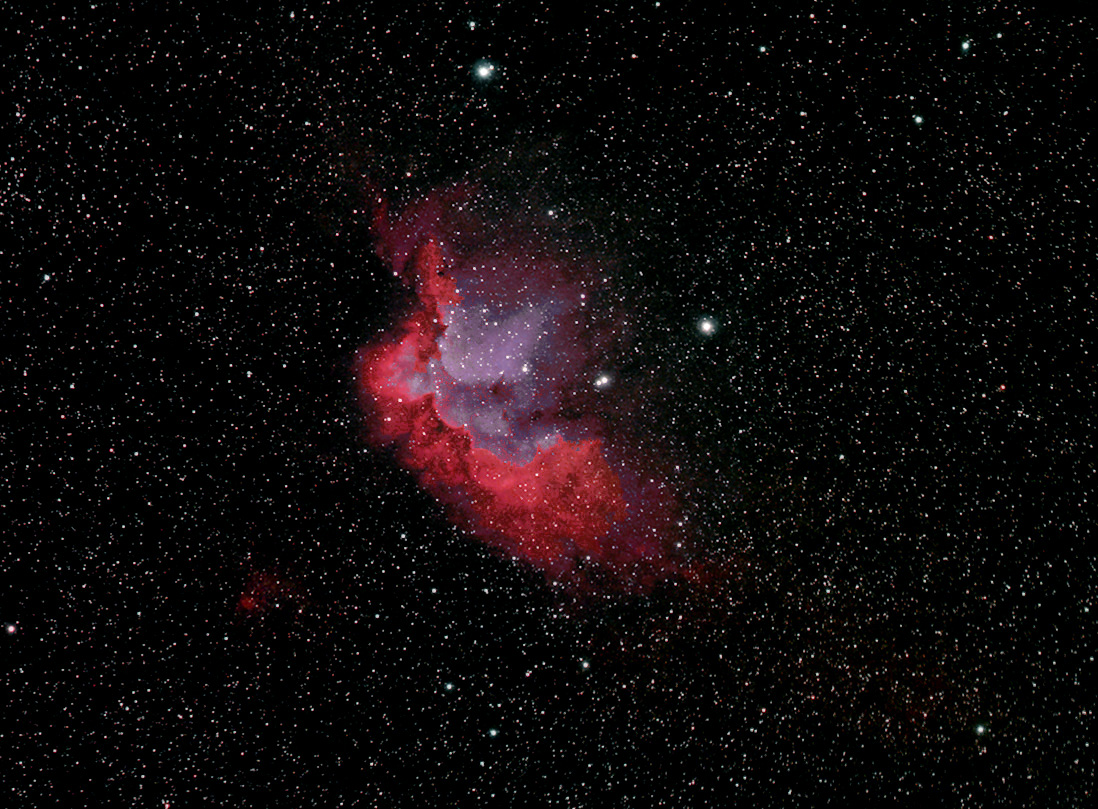 Wizard Nebula (NGC 7380)  Lobster Claw Nebula (Sh2-157)  Bubble Nebula (C11) & M52  Northern Lagoon Nebula (NGC 7538) |
 Scorpian (M52) Open Cluster  Wizard, Bubble,Lobster Claw, Northern Lagoon & M52 |


The Veil Nebula is a large supernova remnant located about 2,400 light-years away in the constellation of Cygnus. The source supernova was a star 20 times more massive than the Sun that exploded between 10,000 and 20,000 years ago, and would have been so bright that it was visible in the daytime. The remnants have since expanded to a size about 6 times the diameter of the full Moon. This nebula has three major components: the Western Veil, Pickering s Triangle, and the Eastern Veil.  Veil Nebula (NGC 6960/92) |
 Eastern Veil Nebula 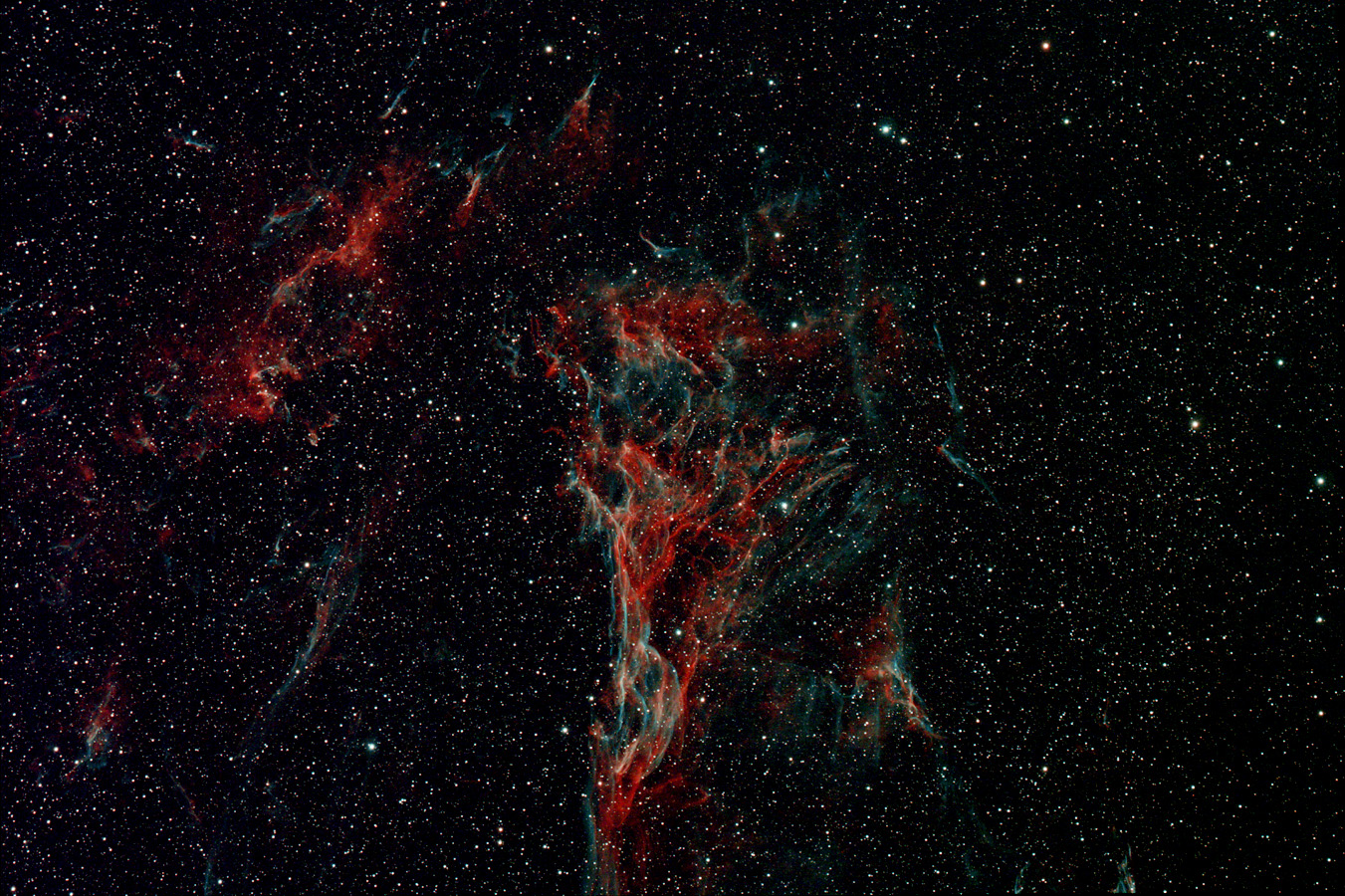 Pickering's Triangle  Western Veil Nebula |
Galaxies
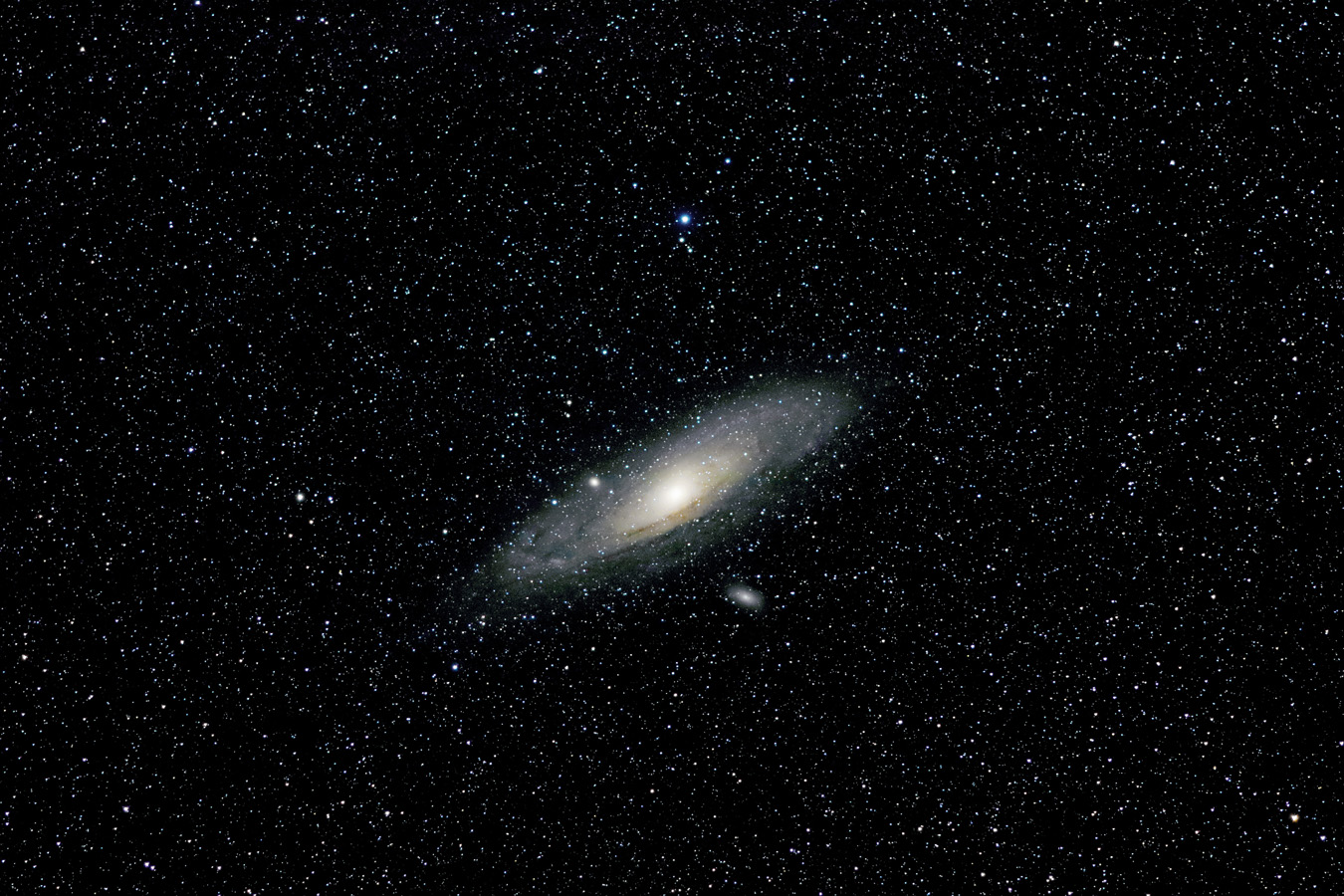
The region around Polaris is rich with galaxies. Andromeda Galaxy (M31), and its companion galaxies M32 and M110, are near the horizon at midnight, and do not rise into good view until the wee hours of the morning. |
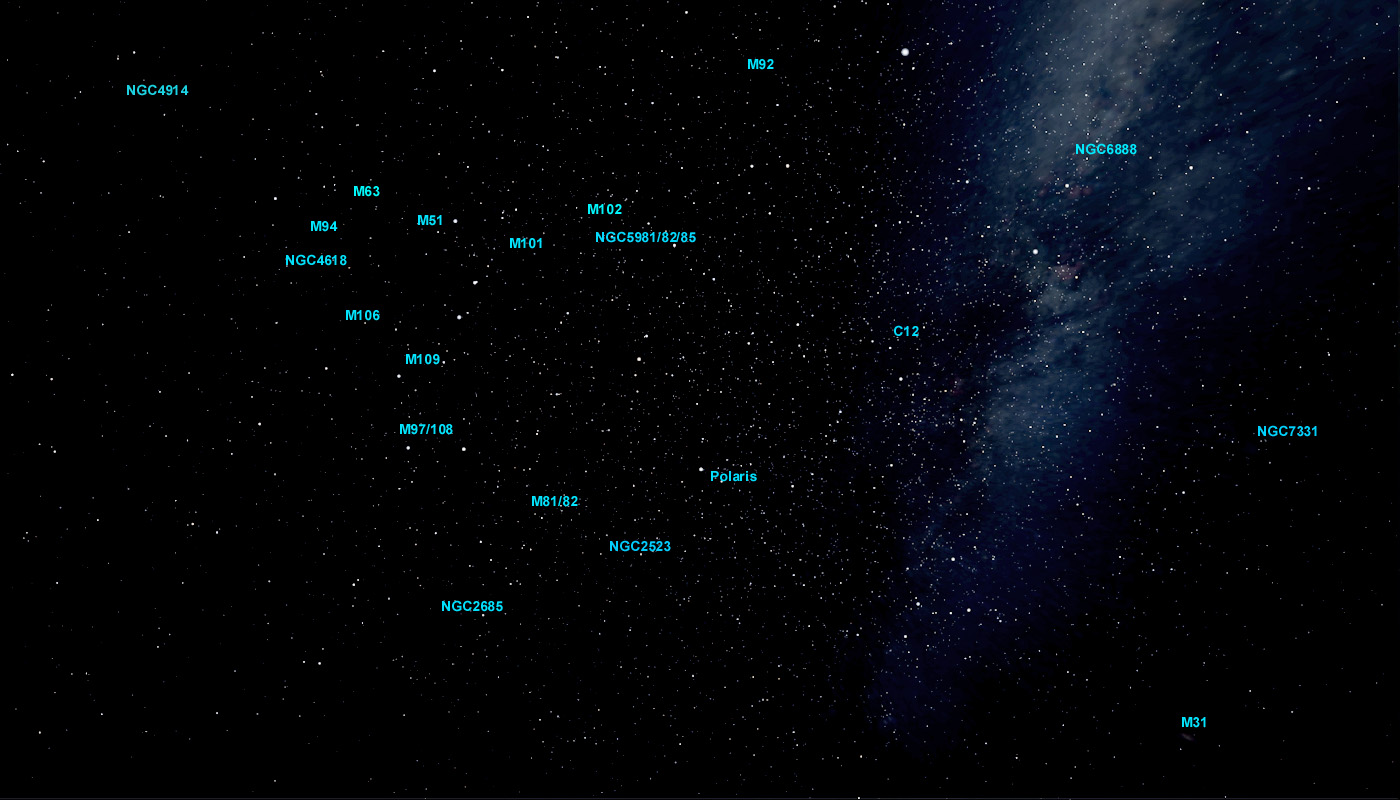 The summer sky looking north at midnight (background image courtesy Stellarium) |
Click on thumbnails for larger images.

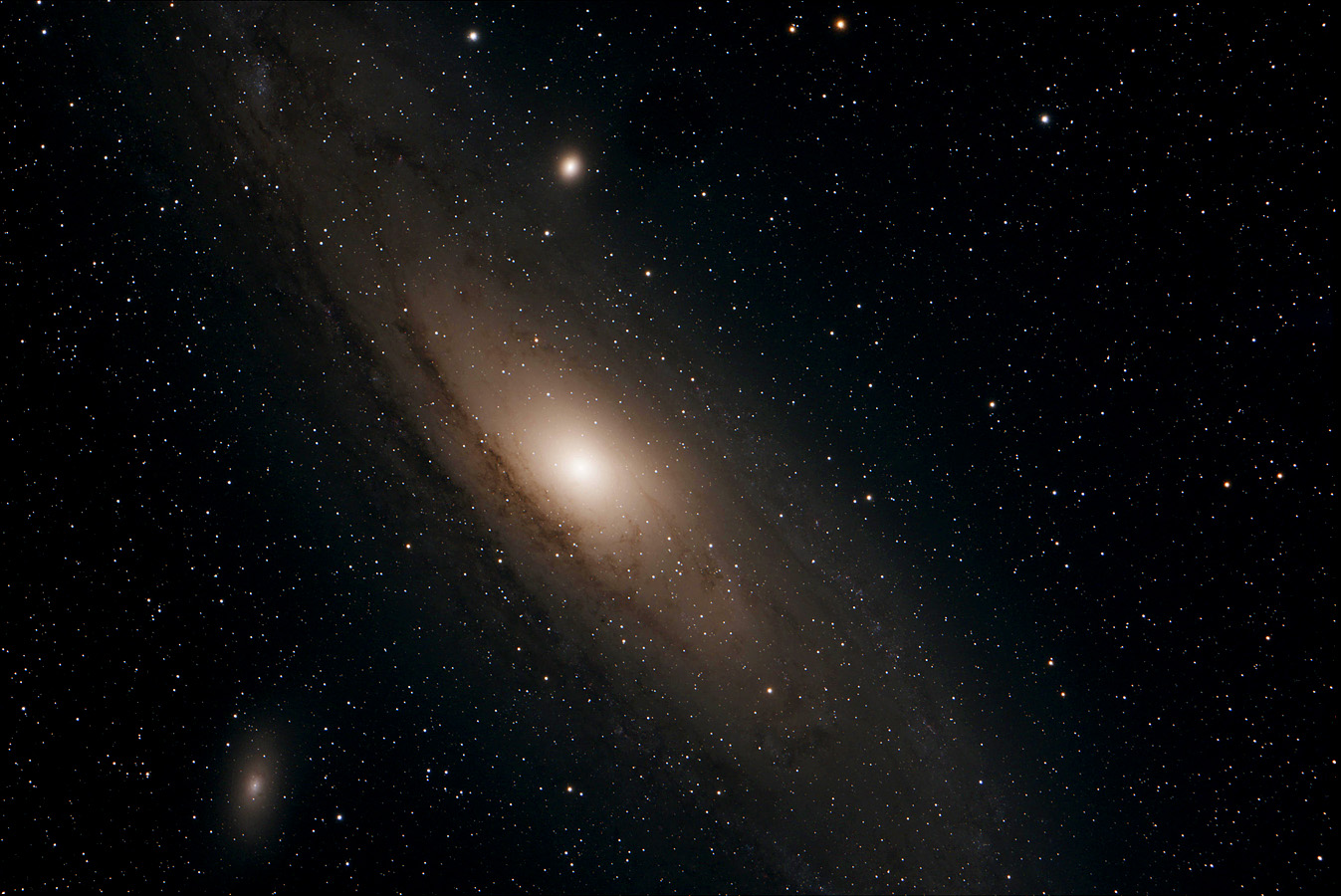


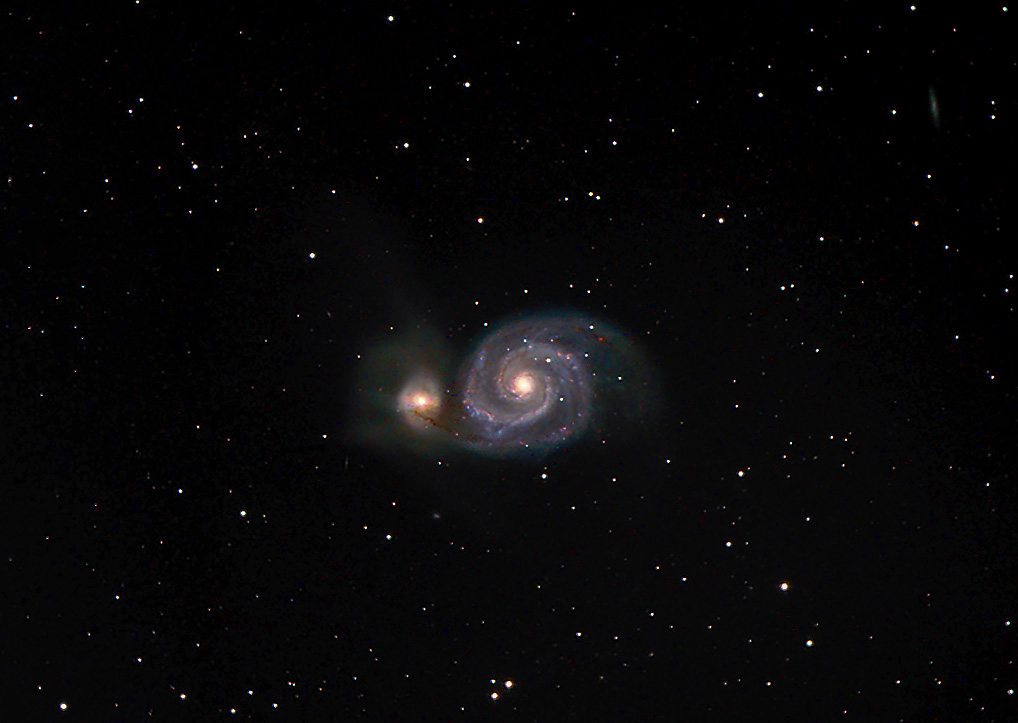


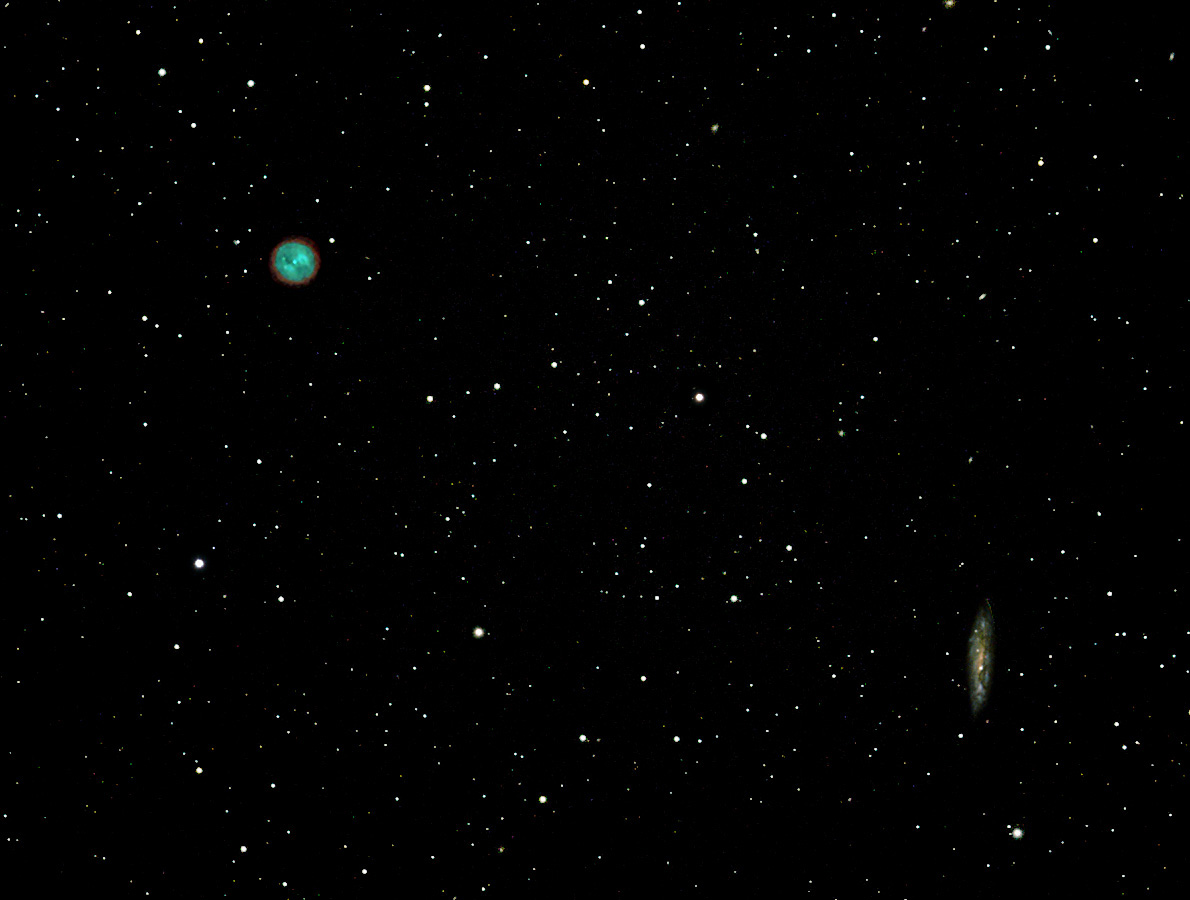


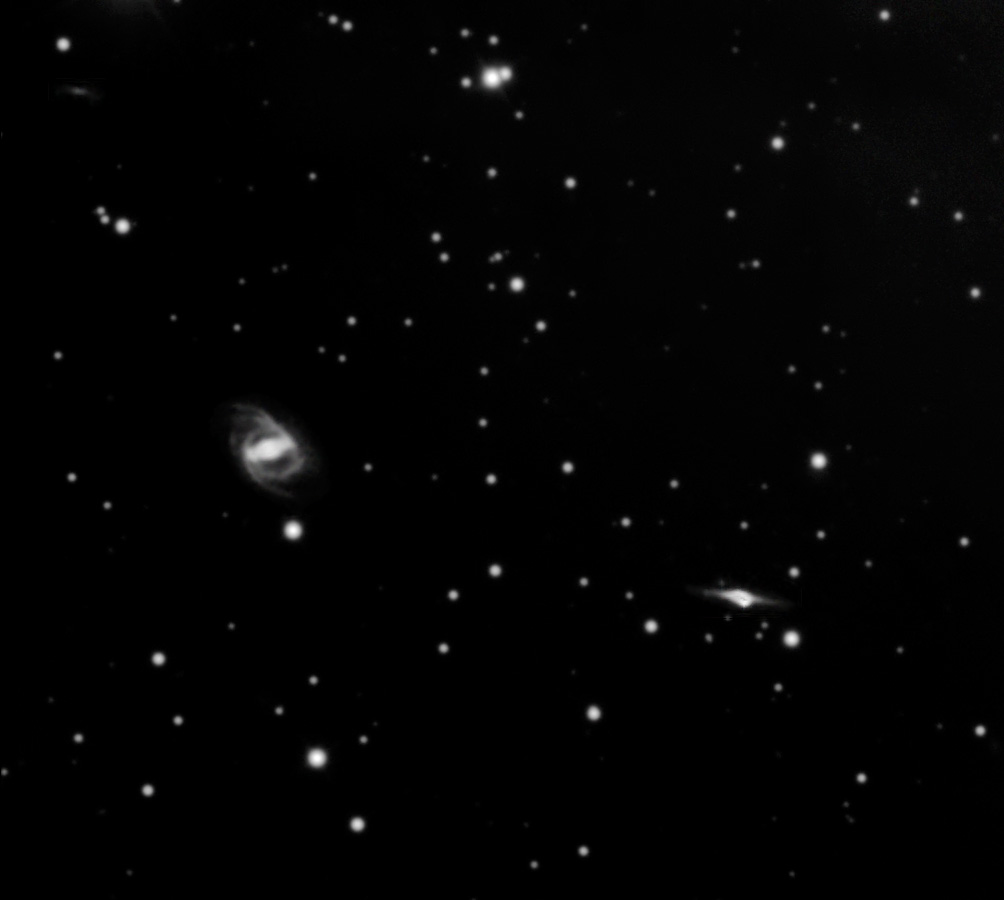



Pinwheel Galaxy (M101) and Supernova SN 2023ixf
 Pinwheel Galaxy (M101)  Pinwheel (M101) Galaxies annotated | |
Supernovae are powerful explosions of stars when their internal nuclear fuel supplies burn out and the stars quickly collapse, resulting in massive shock waves causing stars to explode. Supernova 2023ixf was first observed on 19 May 2023 in the Pinwheel Galaxy (M101), and by 22 May 2023, SN 2023ixf had brightened to about magnitude 11.The supernova started to fade around 10 June 2023. SN 2023ixf is not visible in the 6 April 2024 image. | |
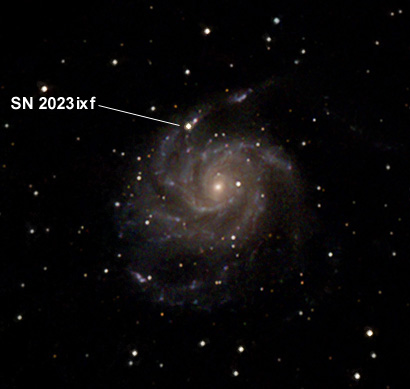 Supernova SN 2023ixf; 3 July 2023 Pinwheel Galaxy (M101) ; 20 May 2025  Supernova SN 2023ixf Pinwheel Galaxy (M101) 19 April 2022-3 July 2023-6 April 2024 |
NGC 7331 Galaxy; Supernovae SN2025rbs and SN2026aaiv
The Gravitational-wave Optical Transient Observer (GOTO), an array of robotic optical telescopes, discovered a supernova (SN 2025rbs) in the NGC 7331 galaxy located in the constellation of Pegasus on July 14, 2025. |
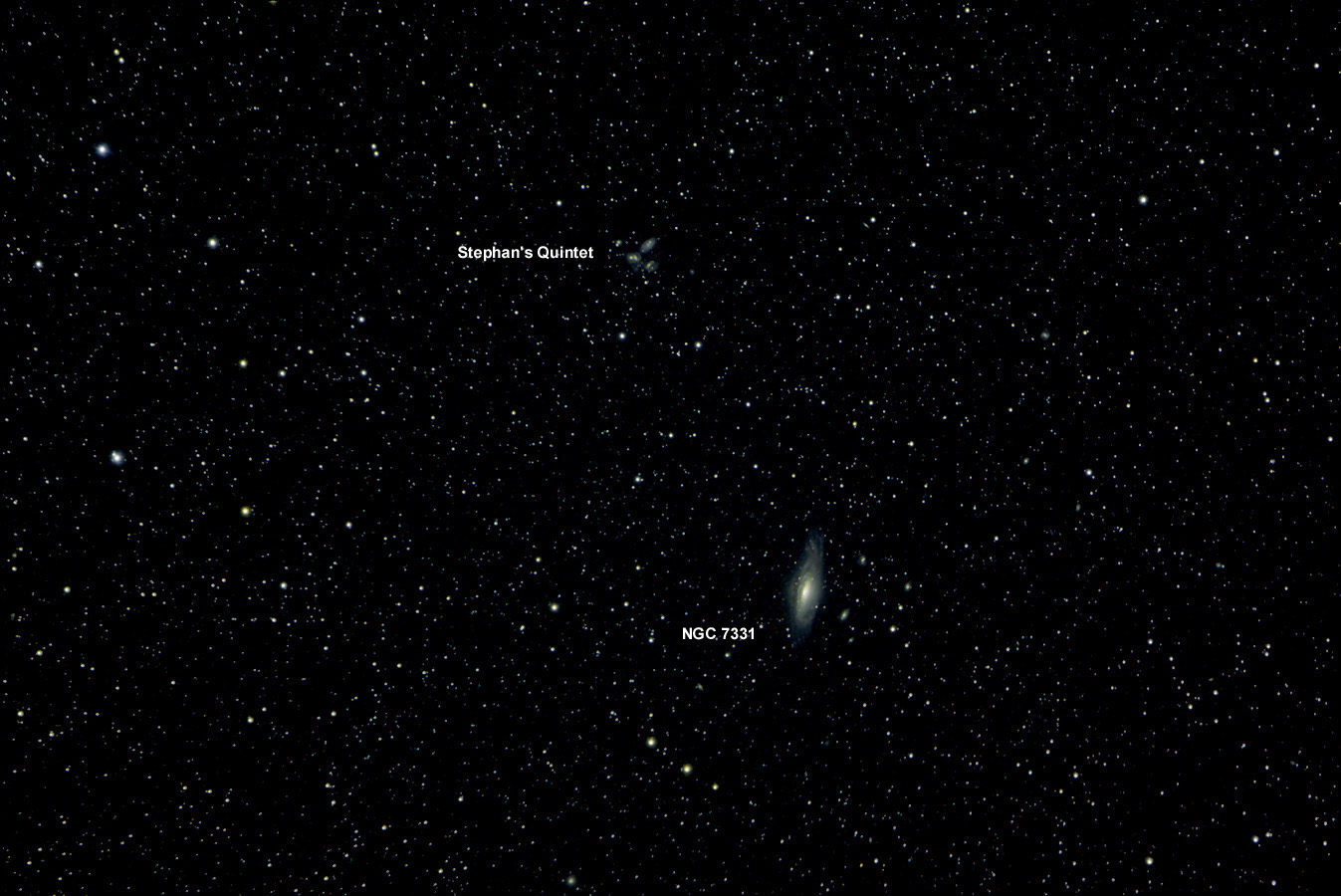 NGC7331 Galaxy & Stephan's Quintet  NGC7331 Galaxy & SN 2025rbs 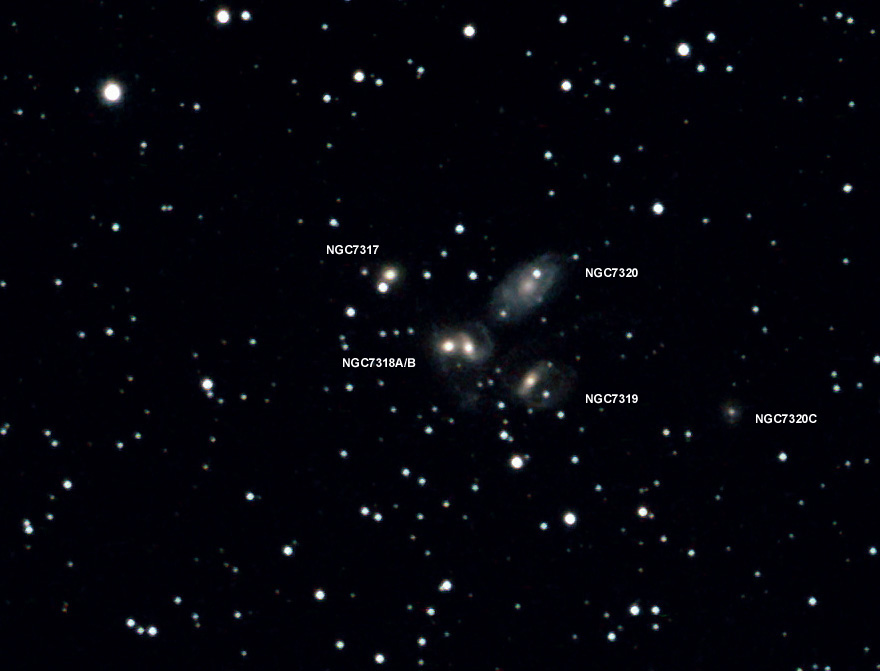 Stephan's Quintet |
NGC 4914 Galaxy and Supernova SN 2026JC
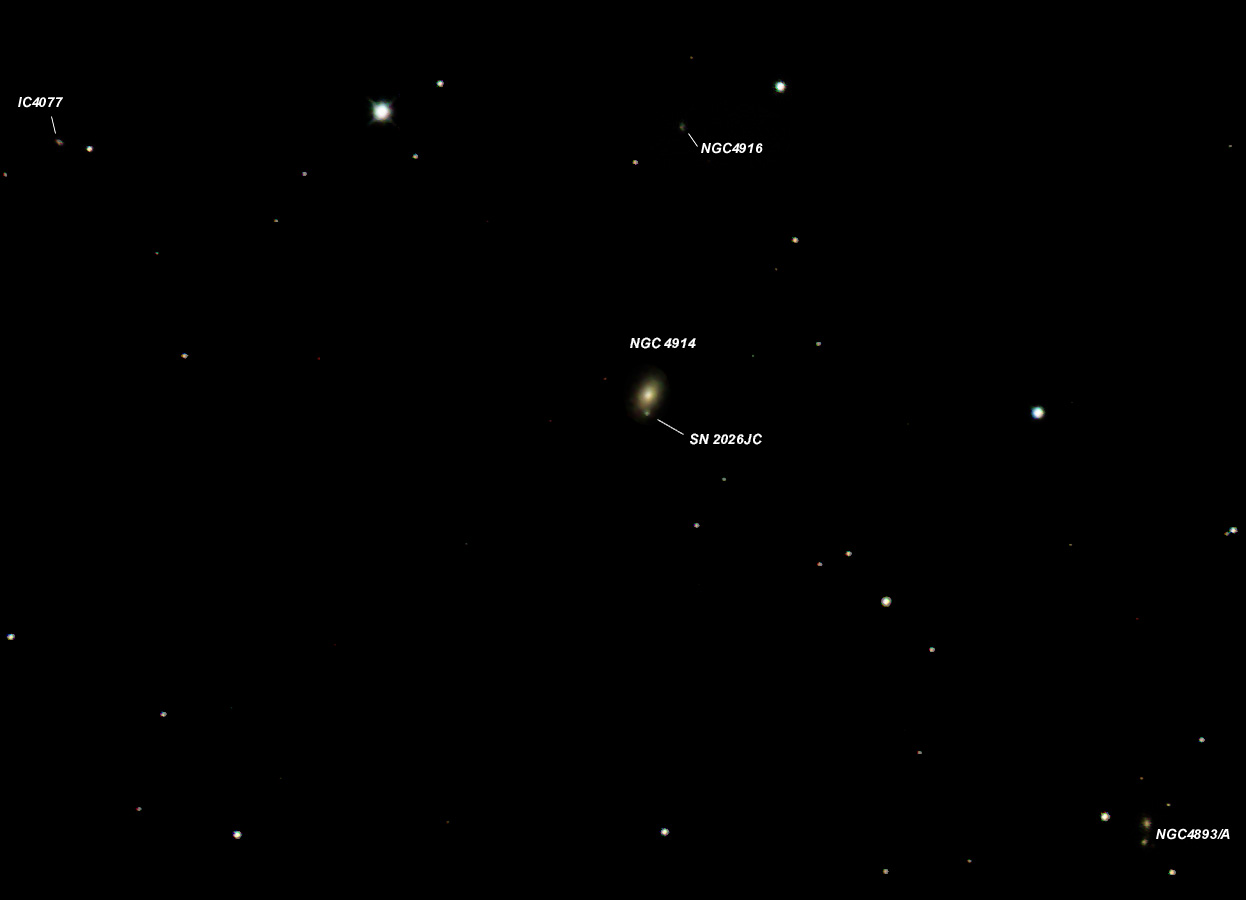 NGC4914 & SN2026JC  NGC4914 & SN2026JC |
 To view DSOs in the eastern sky, you can see them more easily on the Autumn Sky page  To view DSOs in the western sky, you can see them more easily on the Spring Sky page |
Return to my Astrophotography home page