Astrophotography


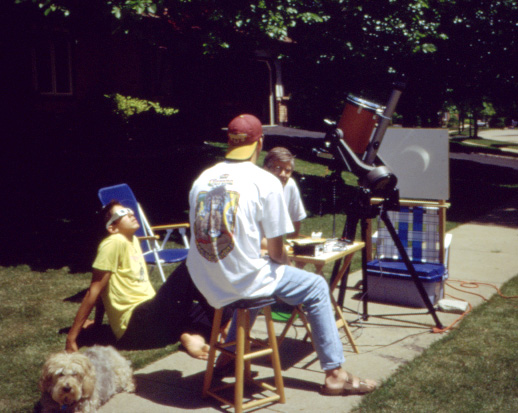
Photographing the October 1994 annular solar eclipse

All photos are © Marshall Faintich

I did a lot of astrophotography in the mid-1980s through the early 1990s, but took a break from this hobby for more than 20 years, other than taking a few eclipse photos. All of my early astrophotos were taken using film based cameras through a Celestron 8-inch telescope, or with a camera piggy-backed on top of the telescope, or with only a tripod.

When I restarted this hobby in 2020, I no longer had a telescope, so I was limited to using only a hand-held or tripod mounted, unmodified digital camera body with standard camera lenses. Later in 2020, I purchased a Star Adventurer tracker for longer exposures. I sometimes use a light pollution filter for photographing emission nebulae, or a lens mounted solar filter for solar imaging. In 2022, I bought a MAK102mm optical tube assembly for planetary imaging.

In December 2024, I began imaging with a Celestron 8-inch telescope on loan from the Charlottesville Astronomical Society, and in January 2025, I began remote imaging with MSRO Science/RAC Observatory telescopes. In September 2026, I began remote imaging using iTelescope equipment located in Australia, Chile, Utah, and California.


My digital observatory


Solar System Objects

Click on photos below to see my Solar System astrophotos


Planets

Sun, Moon, & Aurorae

Comets, Asteroids, & Meteors

Deep Sky Objects

Note that any image with MSRO in the image file name designates raw image data captured remotely with one or more telescopes located at the MSRO Science/RAC Observatory. My contribution to any MSRO final image on my web pages is processing raw image data collected by others, merging such raw image data with my images, or in most cases, my operating the telescopes remotely. (Raw image collection credits: Myron Wasiuta; Pete Laky; Shannon Morgan)

MSRO Science/RAC Observatory is a non-profit 501-c3 entity whose purpose is to provide students, teachers, and amateur astronomers access to high quality imaging telescopes at no cost. Interested individuals can learn more about MSRO by emailing its director at mwasiuta@msroscience.org.


Types of Deep Sky Objects (DSOs)

DSO Examples

Click on links below
to see my DSO astrophotos

Nebulae are clouds of interstellar gas where stars are born as the gaseous material condenses into a tightly packed mass. Emission nebulae have one or more bright stars nearby that cause the gases to emit energy primarily in the reddish hydrogen-alpha part of the spectrum. Reflection nebulae have one or more bright stars nearby but not close enough to cause emission, and only bluish light from the stars is reflected. Dark nebulae do not emit or reflect light, but can be seen if they are in front of bright nebulae.


The Summer Sky

Planetary nebulae are tiny and not like the large emission and reflection nebulae where stars are born. A planetary nebula is a type of emission nebula consisting of an expanding, glowing shell of ionized gas ejected from a star late in its life, and only exists for a few tens of thousands of years. They are also not related to planets, but were given this name when first discovered in the 1700s because they resembled the size and shape of planets.


The Autumn Sky

Galaxies contain hundreds of billlions of stars, and are millions of light-years from Earth. They sometimes are gravitationally bound with other galaxies to form clusters.


The Winter Sky

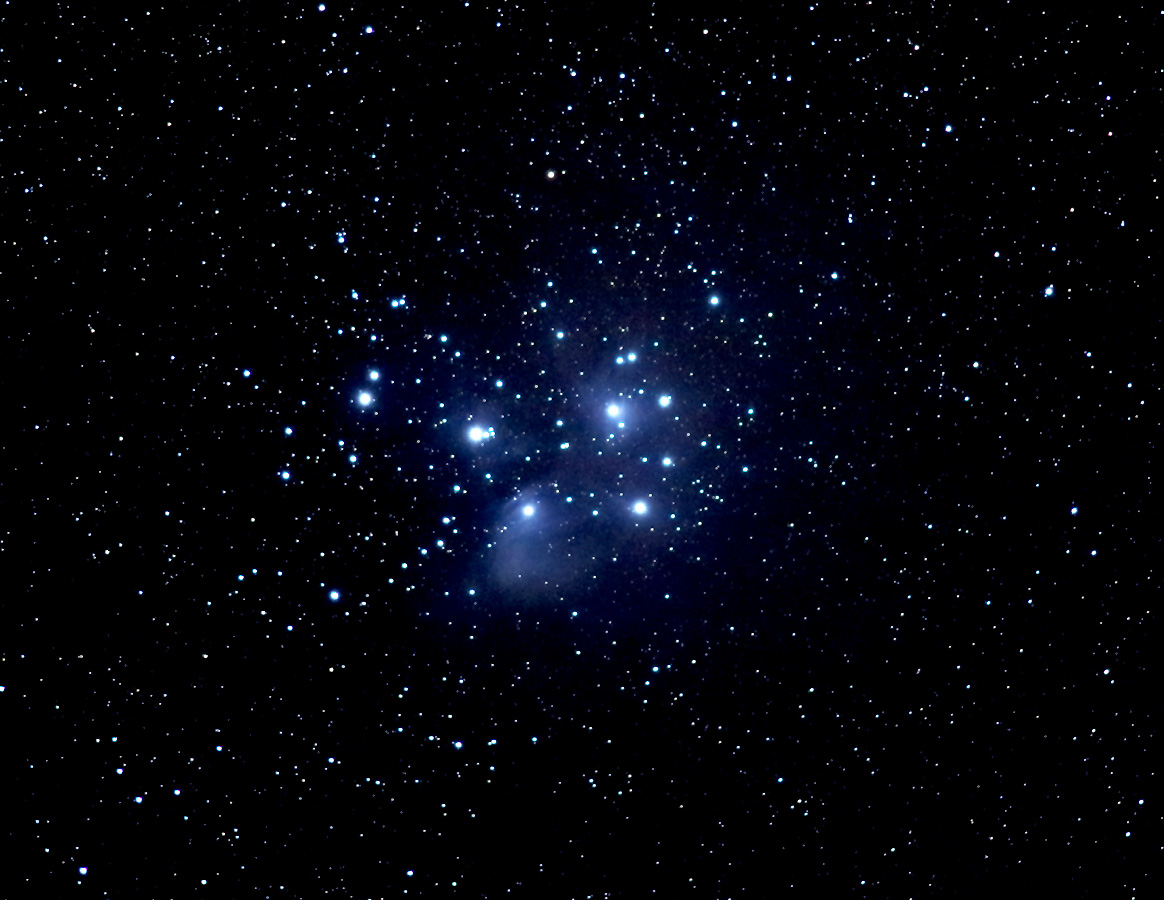
Open star clusters are loosely bound by mutual gravitational attraction.


The Spring Sky

Globular clusters are spheroidal conglomerations of stars, and can contain more than a million stars in a single cluster.


The Celestial Poles

Nightscapes


Orion

The Summer Milky Way

The Milky Way in Cygnus


Pons-Brooks
28 March 2024

Venus, Mars, Jupiter &
Mercury 6 July 1991

Comet Lemmon (C/2025 A6)
3 November 2025

Eta Carina, omega Centauri, Southern Cross, and False Cross

Miscellaneous Images


International Space Station
27 September 2017

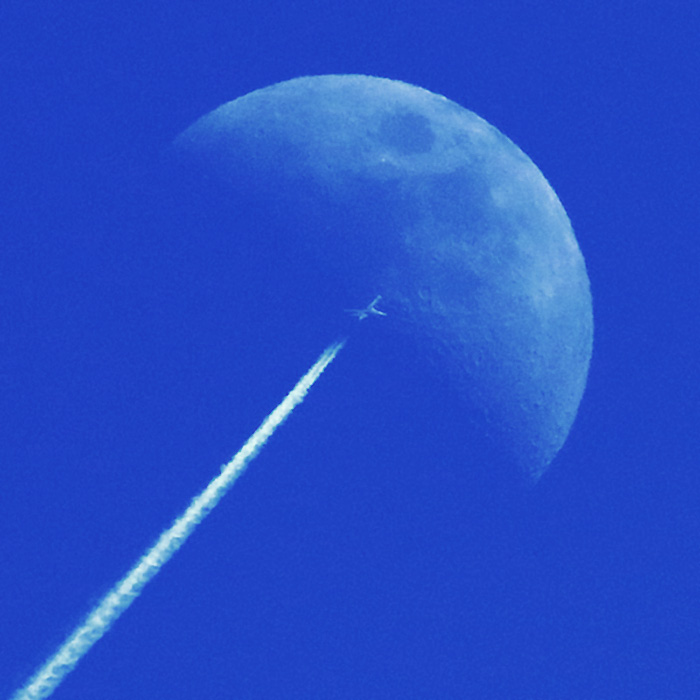
Airplane and Moon
26 February 2023


My first attempts at astrophotography using the 12" diameter, 15 foot long refractor telescope at the
University of Illinois at Urbana-Champaign Observatory. This telescope was built in 1896.

The middle frame shows me using this telescope in 1968.

The third frame is a modern photo of this telescope, and I have superimposed my second astrophoto - Saturn - taken in 1968 with this telescope.

My first astrophoto was of the h&chi double cluster in Perseus, but I do not have that image.


Recommended Links


Charlottesville Astronomical
Society

MSRO Science/RAC
Observatory

Cloudy Nights
Astronomy Forum

Stellarium
Planetarium Software


Return to my web pages home screen


About Marshall Faintich

E-mail me: mbf3258@faintich.net